Shruti Wagh

UX Designer
Associate Researcher
Payments Reconciliation Experience
AJIO Seller Central
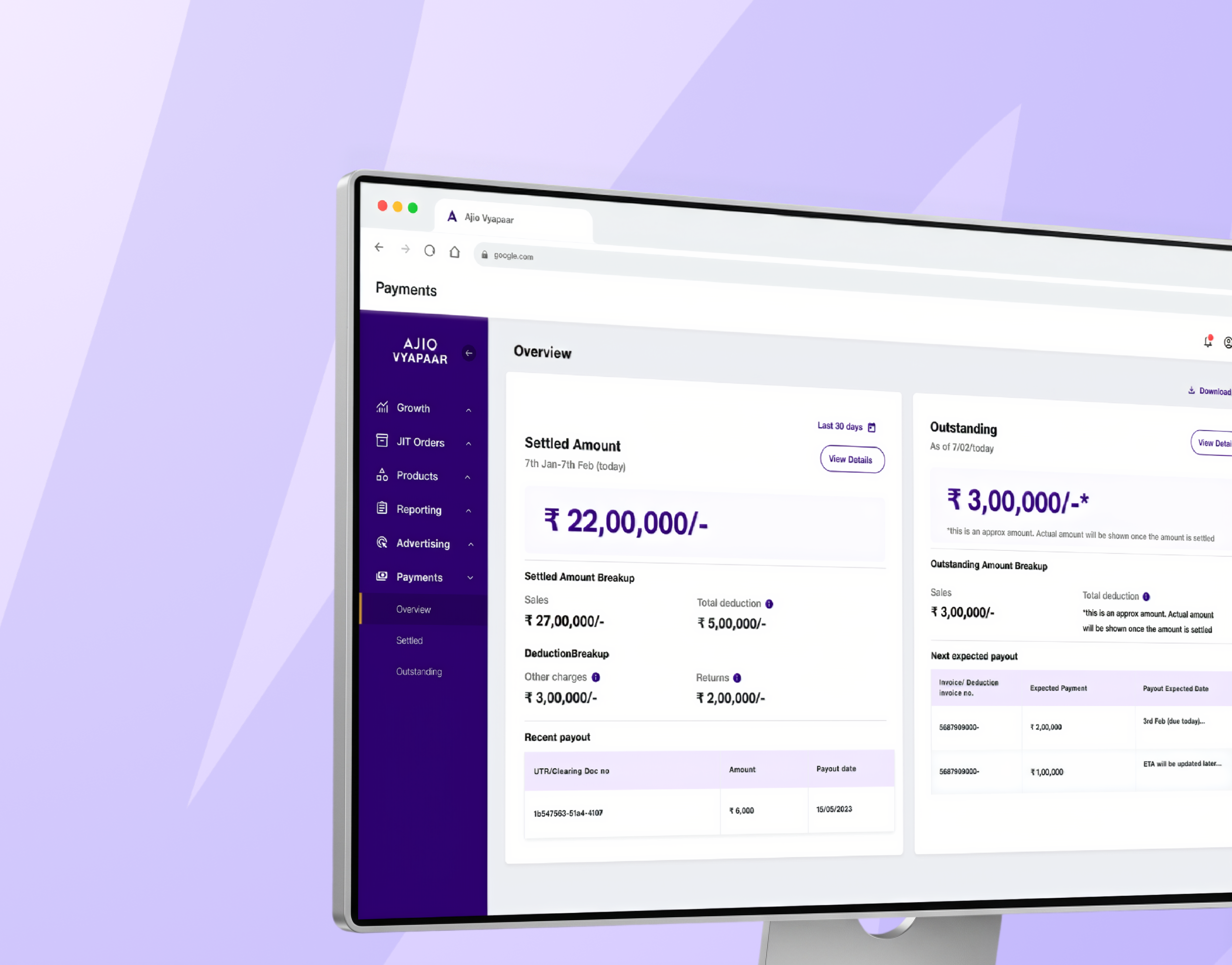
AJIO Seller Central is a business management platform that supports sellers from onboarding and product listing to order fulfilment and payments. By bringing these workflows together with advertising tools and business insights, it helps sellers manage day-to-day operations and grow their reach across India.

Project Overview
Restructured the payments module into a unified, order-first reconciliation experience.
Ajio Seller Central is a B2B platform that enables sellers to manage catalog operations, orders, advertising, payments etc. As a UX designer, I worked with a team of 5 members on redesigning the payments experience to help sellers independently understand and reconcile payouts. Many sellers struggled to track payments, verify deductions, and understand settlement outcomes. The objective of this project was to design a unified and a transparent reconciliation experience aligned with how sellers naturally manage financial workflows.
Problem
Sellers lacked payment visibility due to fragmented data and inefficient verification workflows
01
No single source of truth
Sellers lacked a unified view of payments, with data scattered across multiple reports and systems.
02
Complex and time-consuming reconciliation
Fragmented financial information made it difficult and inefficient to reconcile transactions accurately.
03
Manual and inefficient verification process
Verifying a single payment required cross-checking multiple reports, maintaining external trackers (e.g., Excel), or contacting support.
04
Reduced trust and increased support dependency
These inefficiencies led to lower confidence in the platform and greater reliance on support teams for clarification.
“Ek hi portal mein sab kuch ek systematic process se dikh jaye…”
— (seller on Ajio)


Reconcile Process (Before)
Before diving into research and designing, we carefully understood current process of reconciliation
Overview of sellers payments (Before)
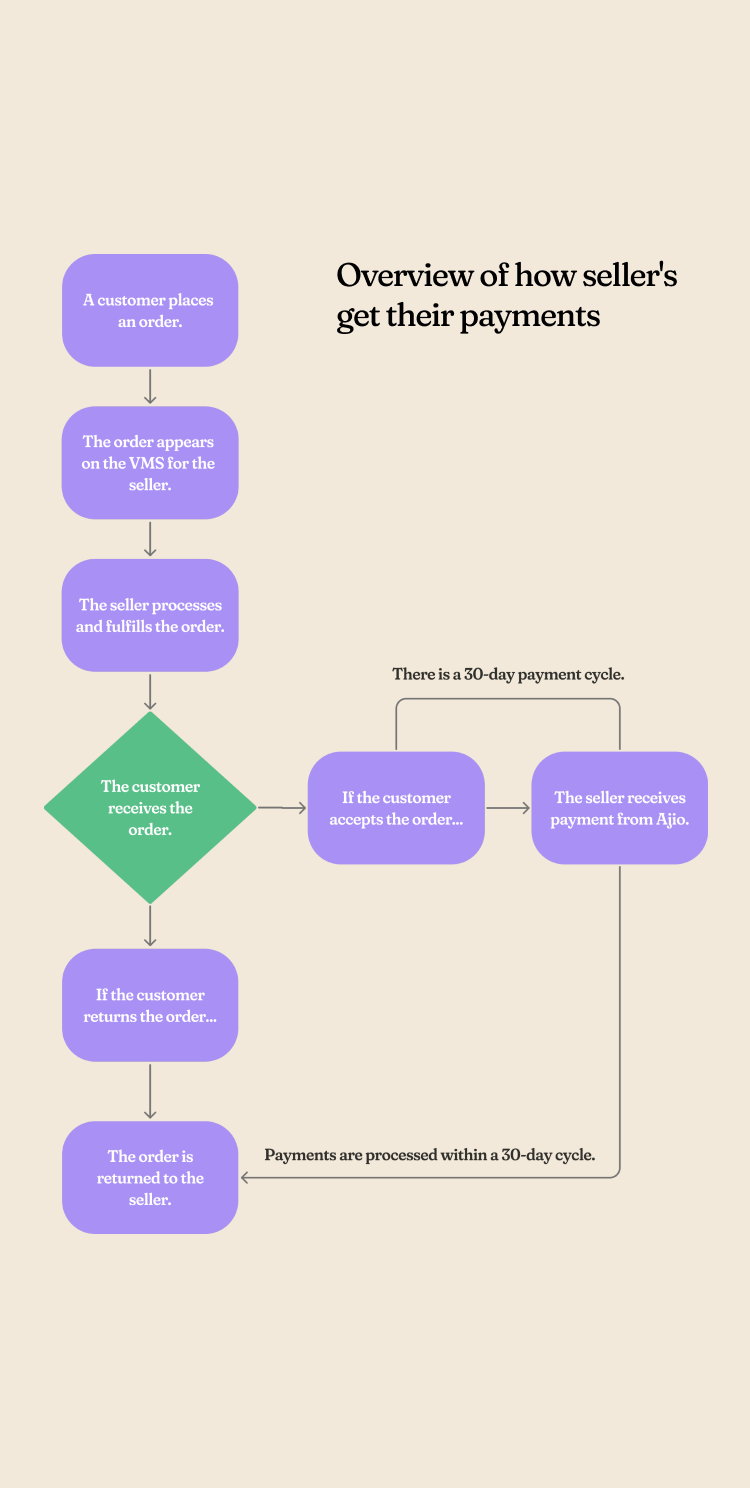
Steps to Reconciliation (Before)

Step 01
Data Collection
- Download FWD Report (Source - VMS Portal)
- Download RTV Report (Source - VMS Portal)
- Download Payments Report (Source - SRM Portal)

Step 02
Manual Data Preparation
- Concatenate/link FWD Invoice and SKU
- Map new column with RTV invoices & SKU
- Combine multiple payments reports from SRM
- Use third-party tools

Step 03
Excel analysis & Reconciliation
- Create a Pivot table to summarize data
- Analyze Payment status

Step 04
Payment outcome understanding
- Payment cleared
- Due later/ outstanding
- Deductions ( lump- sum)
- Payments for returns
- Expected

Step 05
Verification & Support
Run test conversations directly in the platform before going live. Logged separately from live conversations — includes message count and end timestamp. Reviewable in full at any point.
Research Strategy
To grasp seller reconciliation challenges, we created a structured research approach that combines user insights, business constraints, and competitive benchmarking.

Competitive Bench-marking
We analyzed reconciliation and payments workflows across Flipkart, Amazon, Meesho, and Myntra to identify industry standards, gaps, and opportunity areas.

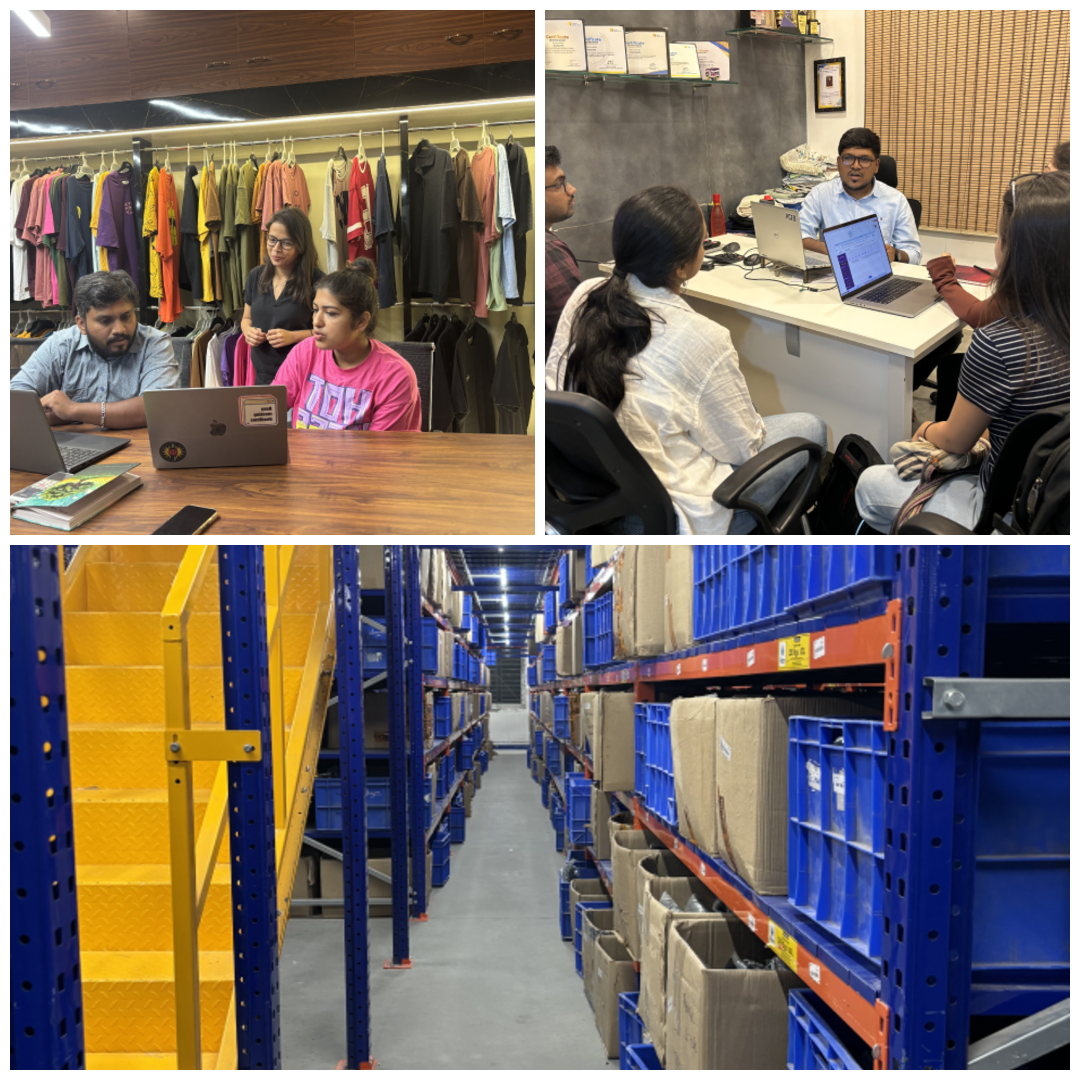
Moderated Seller Interviews
With reasearch team we conducted in-depth interviews with 10+ active sellers, including follow-up sessions to validate patterns and probe reconciliation workflows in real scenarios.

Cross-Functional Stakeholder Collaboration
Worked closely with finance and accounting teams to understand system limitations, reporting logic, deduction structures, and operational constraints.
Wireframes as Research Prototypes
Used early wireframes as discussion artifacts to uncover mental models, validate assumptions, and surface usability friction before finalizing solutions.

Context Setting
Sellers walked through their current reconciliation process and pain points.

Task-Based Exploration
Participants demonstrated how they track payments, identify deductions, and verify order-level details.

Validation & Deep Dive
Explored specific breakdowns, reporting structures, and trust-related concerns.
Synthesis & Pattern Mapping
Mapped recurring themes across sellers to define structural UX gaps.
Research insights
Before diving into research and designing, we carefully understood current process of reconciliation
n = 12 sellers · single choice per question

75%
Use 3+ sources to
reconcile one transaction
(9 out of 12 sellers)

67%
Report low trust in payout accuracy
(8 out of 12 sellers)

92%
Export data to reconcile outside the platform
(11 out of 12 sellers)

01
How do you typically reconcile a payment with its order?
Problem:
There is no single place to view a complete transaction — sellers must manually piece together data from multiple disconnected reports.
Cross-reference 3+ reports
75%
(9)
Use 2 reports
17%
(2)
Platform is sufficient
8%
(1)
So we designed
A unified reconciliation workflow — all payment sources consolidated into a single view, eliminating the need to switch between reports.
02
What is your primary anchor when tracing a payment discrepancy?
Problem:
Payouts arrive as unexplained lump sums — sellers cannot verify what was deducted or why, eroding trust
Invoice no/clearing doc
75%
(9)
Payout date
17%
(2)
Product SKU
8%
(1)
So we designed
An order-first information hierarchy — Order ID is the top-level entry point across the entire interface, mirroring how sellers naturally navigate.
03
When reviewing payments, what do you look at first?
Problem:
The platform presents raw transaction data with no summary layer — sellers must scroll through detailed records to get a basic overview.
Overall payout summary/overview
86%
(9)
Individual order detail
6%
(1)
Fee breakdown first
8%
(1)
So we designed
Progressive disclosure — a summary layer sellers can scan at a glance, with the ability to drill into transaction-level detail on demand.
04
How confident are you that deductions from your payout are correctly explained?
Problem:
Sellers have no way to verify whether deductions from their payout are accurate or justified — the platform provides no itemised breakdown of fees, taxes, or adjustments.
Not confident at all
42%
(9)
Somewhat confident
33%
(2)
Fully confident
25%
(1)
So we designed
Transparent breakdowns — every payout shows itemised fees, taxes, and adjustments so sellers can verify each deduction without guessing.
05
How often do you export payment data to reconcile outside the platform?
Problem:
No single export covers the full picture — sellers download multiple files and stitch them together manually in spreadsheets.
Every payout cycle
70%
(7)
Occasionally
24%
(2)
Never
6%
(1)
So we designed
A consolidated downloadable statement — one export covering orders, fees, and payouts, ready for offline reconciliation without stitching files together.
Solution
A unified reconciliation ecosystem that brings fragmented payment data into a transparent, self-serve experience with clearer traceability and payout visibility.
Solution
01
Unified Reconciliation with Clear Payment State Separation
Consolidated fragmented payment data into a single reconciliation view while clearly separating Settled and Outstanding Payments, giving sellers immediate visibility into received versus pending funds without switching between reports or manually stitching data together.
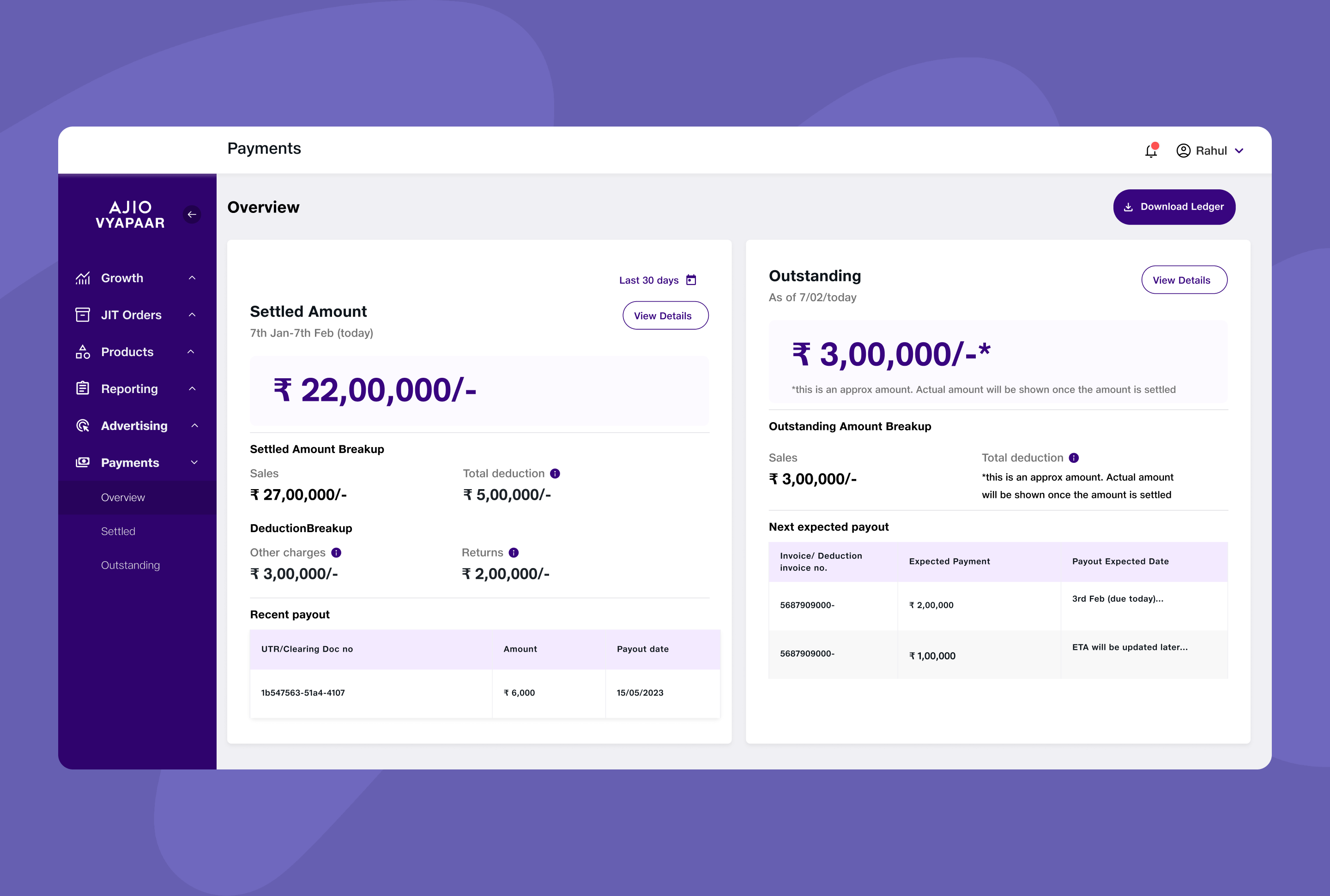
Before
- No single source of truth
- Mixed view of payments with no clear distinction between settled and pending amounts
Now
- One consolidated system
- Clearly separated views for settled and outstanding payments
Solution
02
Invoice & Clearing Document–First Reconciliation Flow
Re-structured the reconciliation experience around Invoice and Clearing Document IDs as the primary anchors, aligning the interface with real payment processing workflows while improving traceability and simplifying reconciliation.
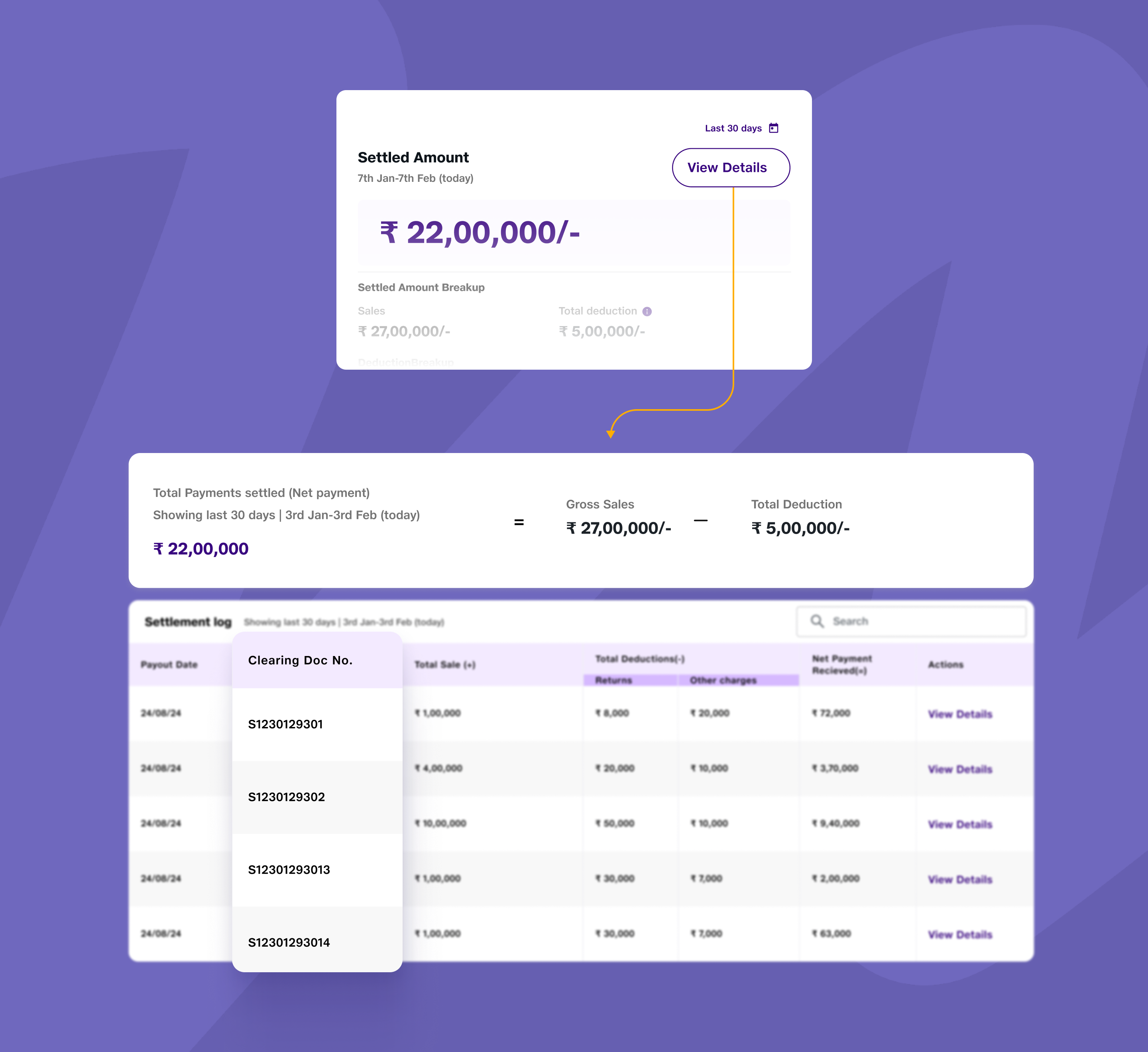
Users have the ability to thoroughly investigate cleared payments by accessing detailed information about settled payments. They can drill down into specific transactions by utilizing the clearing document number as their reference point.
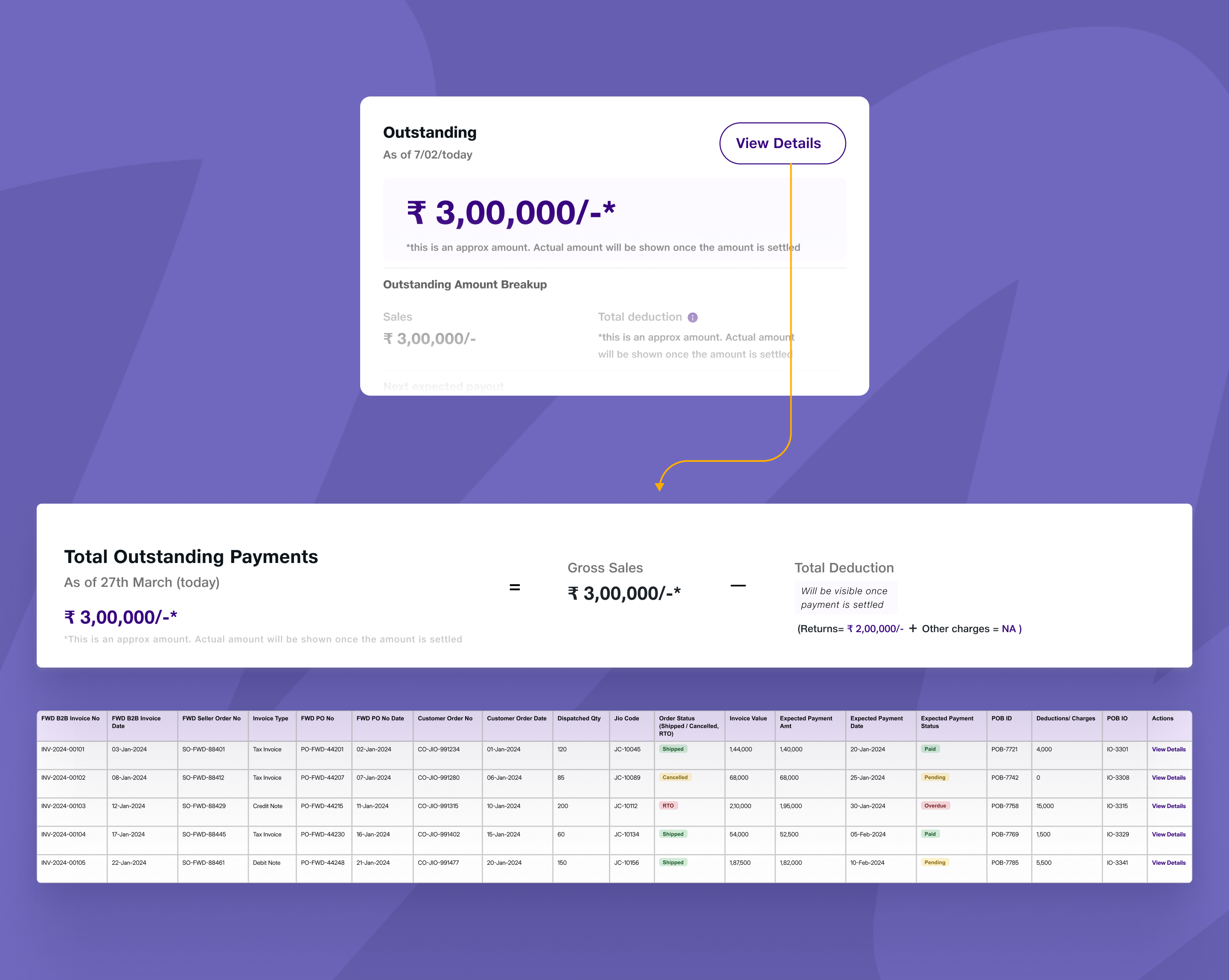
Users can investigate outstanding payments by reviewing outstanding details and drilling down into specific transactions using the invoice number as the anchor.
Before
- Not structured around invoice or clearing documents, forcing sellers to manually piece together payment records and making reconciliation difficult to follow.
Now
- Invoice and Clearing Documents act as the primary reconciliation anchors, creating a more traceable and workflow-aligned payment experience.
Solution
03
Itemised Breakdown of Returns, Charges & Adjustments
Replaced opaque lump-sum deductions with detailed, drill-down breakdowns that clearly surface returns, charges, and adjustments, helping sellers understand exactly how deductions are calculated.
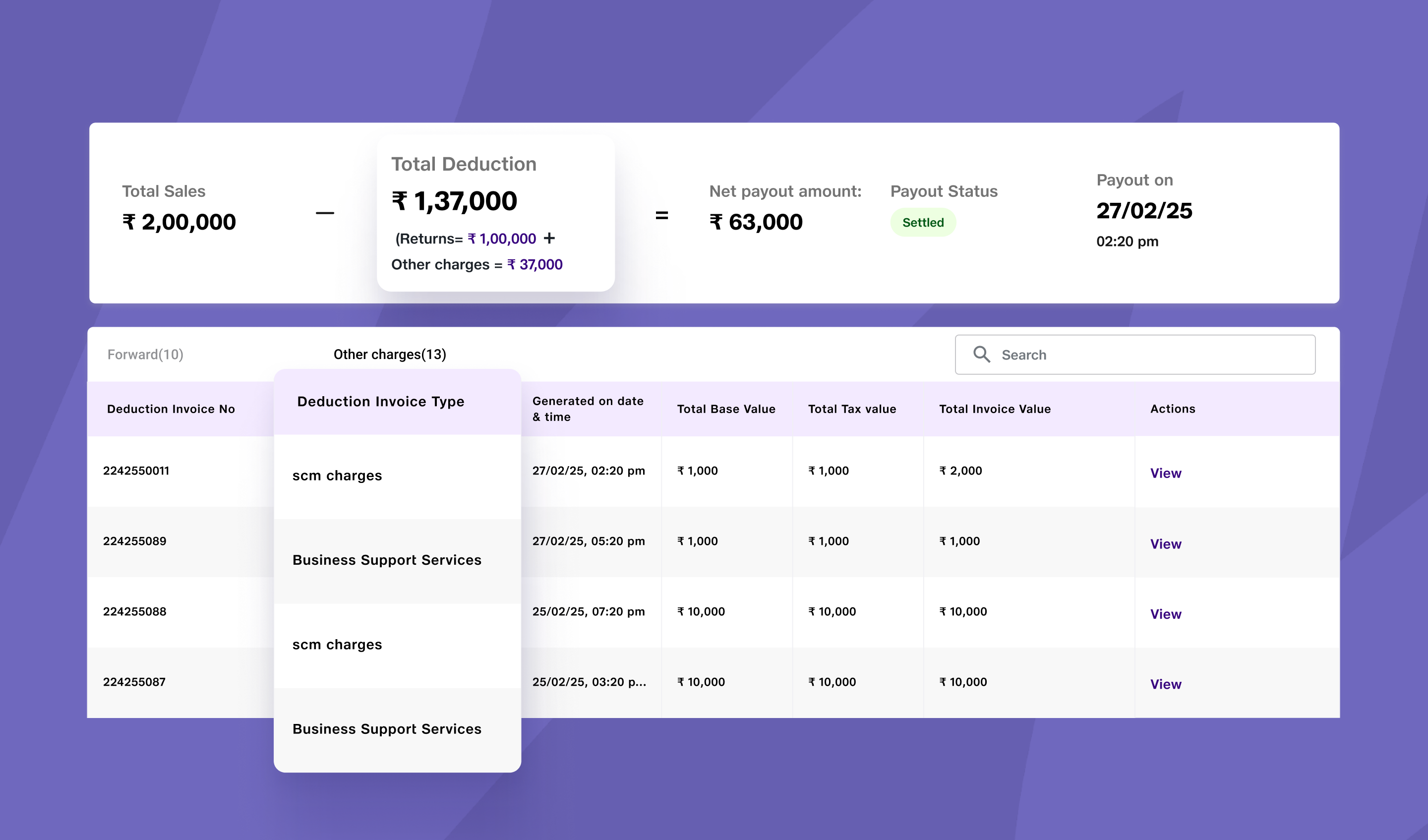
Before
- Deductions appeared as lump-sum amounts with little visibility into individual charges, returns, or payment adjustments.
Now
- Detailed, itemised deduction breakdowns provide clear visibility into every return, charge, and adjustment contributing to the final amount.
Solution
04
Overview - Drill down (Progressive Disclosure)
Introduced a layered information model—starting with a high-level financial snapshot and enabling deeper exploration only when needed.
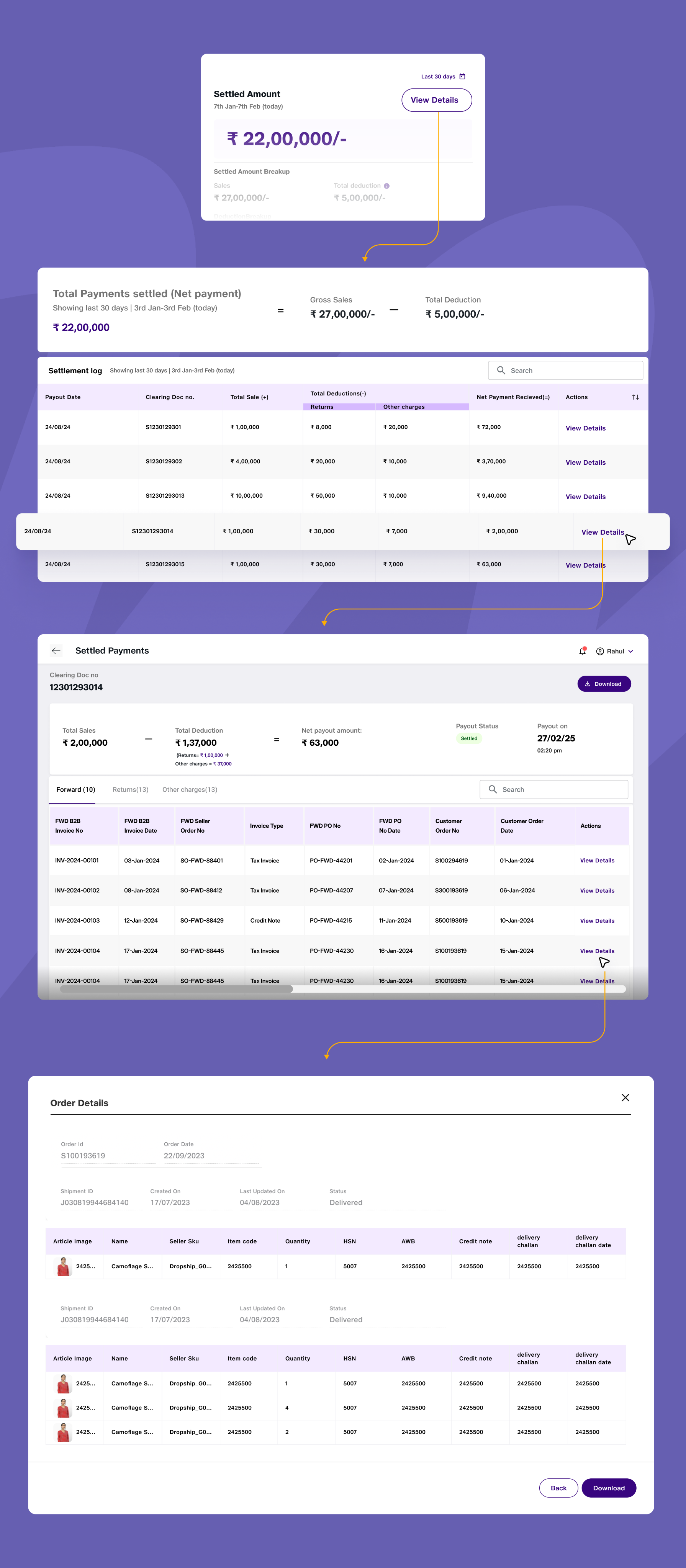
Before
- Flat data with no clear navigation between summary and details
Now
- Seamless flow from overview to clearing docs to line-item details
Solution
05
Export-Ready Reconciliation
Designed exportable, structured data aligned with sellers’ offline workflows—making reconciliation faster and reducing dependency on manual tracking.
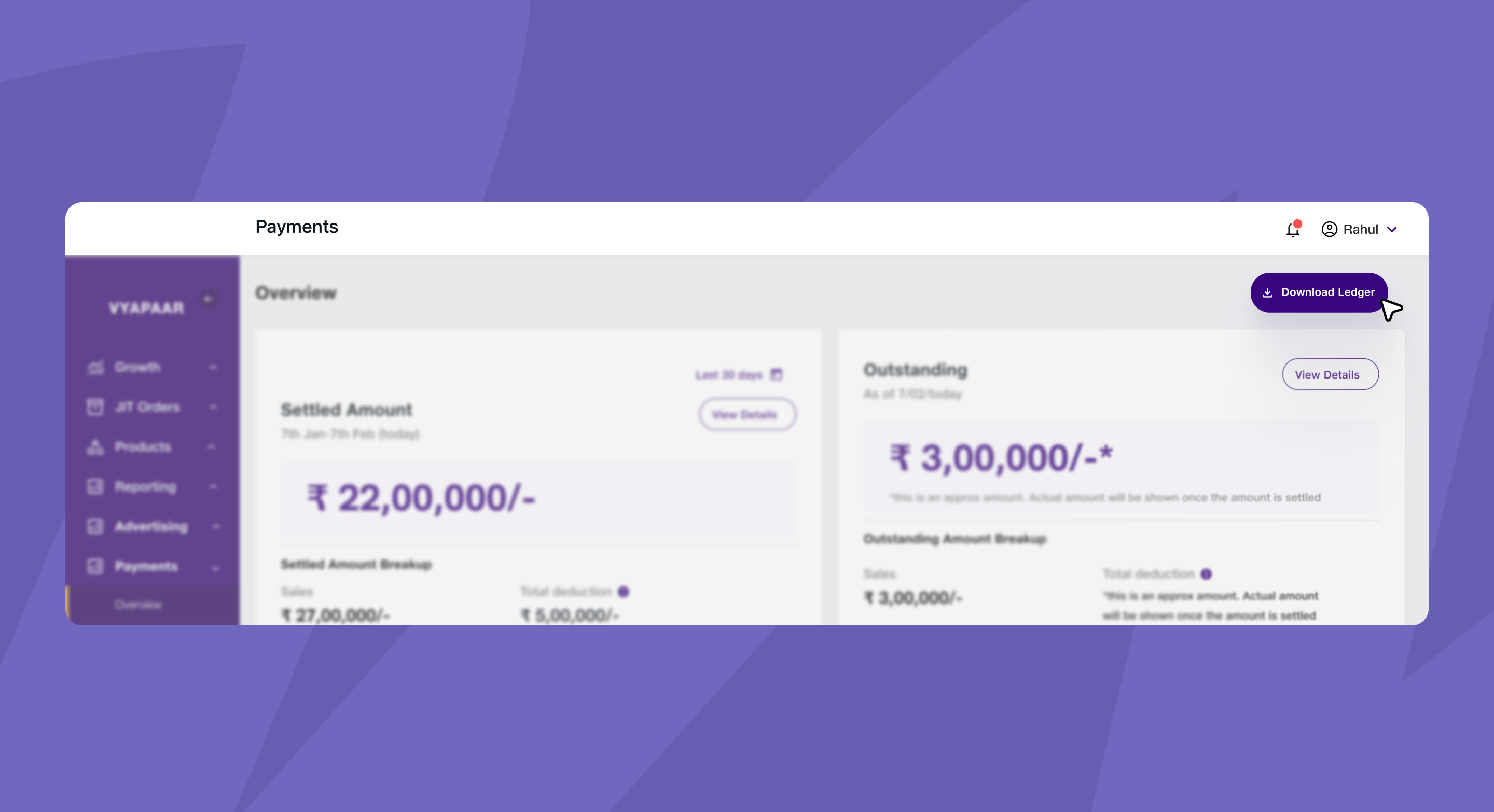
Before
- Sellers manually stitched and tracked payment data outside the platform
Now
- Structured ledger exports supporting faster offline reconciliation
Design Impact
Reconciliation redesign:
from fragmented to self-serve
This solution shifts reconciliation from a manual, multi-report process to a transparent self-serve system — giving sellers clarity, control, and confidence in their payouts.
From Complexity to Clarity

Before — old experience

3+ separate reports
Fragmented, siloed data across multiple files

Manual Excel reconciliation
Error-prone, time-consuming, no single source of truth

Lump-sum deductions
No line-item breakdown; sellers can't verify charges

Support dependency
Sellers rely on ops team to answer basic payout queries


After — new experience

1 unified view
All payout data consolidated in a single dashboard

Built-in reconciliation
Automated matching, instantly accurate and auditable

Transparent breakdown
Every deduction itemised; sellers can trace each line

Self-serve clarity
Sellers resolve queries independently, no ops needed
Impact metrics

Testing approach
Moderated task-based usability sessions

Conducted task-based usability testing with real sellers
Sample size: n = 12 sellers across segments
Each participant completed tasks independently without guidance
Behavioural insights used to estimate downstream impact

Result: 11 out of 12 sellers completed all tasks independently

Key tasks tested
Three core seller payout scenarios
1
Identify settled vs outstanding payments in the payout dashboard
2
Trace a specific payment via invoice number or clearing document
3
Understand and verify individual deductions with line-item breakdown
All other impact metrics (↓ Support, ↑ Trust, ↑ NPS) are estimated based on behavioural improvements observed during testing — not directly measured.

80%
Usability success
11 of 12 sellers completed all tasks independently

Measured

↓ Support
Dependency reduced
Clear self-serve flows reduce ops team load

Estimated

↑ Trust
Seller confidence
Transparent breakdowns improve payout
confidence

Estimated

↑ NPS
Projected uplift
Improved clarity and usability enhance
satisfaction

Projected
UX Designer
Associate Researcher
Payments Reconciliation Experience
AJIO Seller Central
AJIO Seller Central is a business management platform that supports sellers from onboarding and product listing to order fulfilment and payments. By bringing these workflows together with advertising tools and business insights, it helps sellers manage day-to-day operations and grow their reach across India.
Project Overview
Restructured the payments module into a unified, order-first reconciliation experience.
Ajio Seller Central is a B2B platform that enables sellers to manage catalog operations, orders, advertising, payments etc. As a UX designer, I worked with a team of 5 members on redesigning the payments experience to help sellers independently understand and reconcile payouts. Many sellers struggled to track payments, verify deductions, and understand settlement outcomes. The objective of this project was to design a unified and a transparent reconciliation experience aligned with how sellers naturally manage financial workflows.
Problem
Sellers lacked payment visibility due to fragmented data and inefficient verification workflows
01
No single source of truth
Sellers lacked a unified view of payments, with data scattered across multiple reports and systems.
02
Complex and time-consuming reconciliation
Fragmented financial information made it difficult and inefficient to reconcile transactions accurately.
03
Manual and inefficient verification process
Verifying a single payment required cross-checking multiple reports, maintaining external trackers (e.g., Excel), or contacting support.
04
Reduced trust and increased support dependency
These inefficiencies led to lower confidence in the platform and greater reliance on support teams for clarification.
“Ek hi portal mein sab kuch ek systematic process se dikh jaye…”
— (seller on Ajio)


Reconcile Process (Before)
Before diving into research and designing, we carefully understood current process of reconciliation
Overview of sellers payments (Before)
Steps to Reconciliation (Before)
Step 01
Data Collection
- Download FWD Report (Source - VMS Portal)
- Download RTV Report (Source - VMS Portal)
- Download Payments Report (Source - SRM Portal)
Step 02
Manual Data Preparation
- Concatenate/link FWD Invoice and SKU
- Map new column with RTV invoices & SKU
- Combine multiple payments reports from SRM
- Use third-party tools
Step 03
Excel analysis & Reconciliation
- Create a Pivot table to summarize data
- Analyze Payment status
Step 04
Payment outcome understanding
- Payment cleared
- Due later/ outstanding
- Deductions ( lump- sum)
- Payments for returns
- Expected

Step 05
Verification & Support
Map data in seller internal system
Raise request / call the support team
Research Strategy
To grasp seller reconciliation challenges, we created a structured research approach that combines user insights, business constraints, and competitive benchmarking.


Competitive Bench-marking
We analyzed reconciliation and payments workflows across Flipkart, Amazon, Meesho, and Myntra to identify industry standards, gaps, and opportunity areas.

Moderated Seller Interviews
With reasearch team we conducted in-depth interviews with 10+ active sellers, including follow-up sessions to validate patterns and probe reconciliation workflows in real scenarios.

Cross-Functional Stakeholder Collaboration
Worked closely with finance and accounting teams to understand system limitations, reporting logic, deduction structures, and operational constraints.
Wireframes as Research Prototypes
Used early wireframes as discussion artifacts to uncover mental models, validate assumptions, and surface usability friction before finalizing solutions.
Context Setting
Sellers walked through their current reconciliation process and pain points.
Task-Based Exploration
Participants demonstrated how they track payments, identify deductions, and verify order-level details.
Validation & Deep Dive
Explored specific breakdowns, reporting structures, and trust-related concerns.
Synthesis & Pattern Mapping
Mapped recurring themes across sellers to define structural UX gaps.
Research insights
Before diving into research and designing, we carefully understood current process of reconciliation
n = 12 sellers · single choice per question
75%
Use 3+ sources to
reconcile one transaction
(9 out of 12 sellers)
67%
Report low trust in payout accuracy
(8 out of 12 sellers)
92%
Export data to reconcile outside the platform
(11 out of 12 sellers)
01
How do you typically reconcile a payment with its order?
Problem:
There is no single place to view a complete transaction — sellers must manually piece together data from multiple disconnected reports.
Cross-reference 3+ reports
75%
(9)
Use 2 reports
17%
(2)
Platform is sufficient
8%
(1)
So we designed
A unified reconciliation workflow — all payment sources consolidated into a single view, eliminating the need to switch between reports.
02
What is your primary anchor when tracing a payment discrepancy?
Problem:
Payouts arrive as unexplained lump sums — sellers cannot verify what was deducted or why, eroding trust
Invoice no/clearing doc
75%
(9)
Payout date
17%
(2)
Product SKU
8%
(1)
So we designed
An order-first information hierarchy — Order ID is the top-level entry point across the entire interface,
mirroring how sellers naturally navigate.
03
When reviewing payments, what do you look at first?
Problem:
The platform presents raw transaction data with no summary layer — sellers must scroll through detailed records to get a basic overview.
Overall payout summary/overview
86%
(9)
Individual order detail
6%
(1)
Fee breakdown first
8%
(1)
So we designed
Progressive disclosure — a summary layer sellers can scan at a glance, with the ability to drill into
transaction-level detail on demand.
04
How confident are you that deductions from your payout are correctly explained?
Problem:
Sellers have no way to verify whether deductions from their payout are accurate or justified — the platform provides no itemised breakdown of fees, taxes, or adjustments.
Not confident at all
42%
(9)
Somewhat confident
33%
(2)
Fully confident
25%
(1)
So we designed
Transparent breakdowns — every payout shows itemised fees, taxes, and adjustments so sellers can verify each deduction without guessing.
05
How often do you export payment data to reconcile outside the platform?
Problem:
No single export covers the full picture — sellers download multiple files and stitch them together manually in spreadsheets.
Every payout cycle
70%
(7)
Occasionally
24%
(2)
Never
6%
(1)
So we designed
A consolidated downloadable statement — one export covering orders, fees, and payouts, ready for offline reconciliation without stitching files together.
Solution
A unified reconciliation ecosystem that brings fragmented payment data into a transparent, self-serve experience with clearer traceability and payout visibility.
Solution
01
Unified Reconciliation with Clear Payment State Separation
Consolidated fragmented payment data into a single reconciliation view while clearly separating Settled and Outstanding Payments, giving sellers immediate visibility into received versus pending funds without switching between reports or manually stitching data together.
Before
- No single source of truth
- Mixed view of payments with no clear distinction between settled and pending amounts
Now
- One consolidated system
- Clearly separated views for settled and outstanding payments
Solution
02
Invoice & Clearing Document–First Reconciliation Flow
Re-structured the reconciliation experience around Invoice and Clearing Document IDs as the primary anchors, aligning the interface with real payment processing workflows while improving traceability and simplifying reconciliation.
Users have the ability to thoroughly investigate cleared payments by accessing detailed information about settled payments. They can drill down into specific transactions by utilizing the clearing document number as their reference point.
Users can investigate outstanding payments by reviewing outstanding details and drilling down into specific transactions using the invoice number as the anchor.
Before
- Not structured around invoice or clearing documents, forcing sellers to manually piece together payment records and making reconciliation difficult to follow.
Now
- Invoice and Clearing Documents act as the primary reconciliation anchors, creating a more traceable and workflow-aligned payment experience.
Solution
03
Itemised Breakdown of Returns, Charges & Adjustments
Replaced opaque lump-sum deductions with detailed, drill-down breakdowns that clearly surface returns, charges, and adjustments, helping sellers understand exactly how deductions are calculated.
Before
- Deductions appeared as lump-sum amounts with little visibility into individual charges, returns, or payment adjustments.
Now
- Detailed, itemised deduction breakdowns provide clear visibility into every return, charge, and adjustment contributing to the final amount.
Solution
04
Overview - Drilldown (Progressive Disclosure)
Introduced a layered information model—starting with a high-level financial snapshot and enabling deeper exploration only when needed.
Before
- Flat data with no clear navigation between summary and details
Now
- Seamless flow from overview to clearing docs to line-item details
Solution
05
Export-Ready Reconciliation
Designed exportable, structured data aligned with sellers’ offline workflows—making reconciliation faster and reducing dependency on manual tracking.
Before
- Sellers manually stitched and tracked payment data outside the platform
Now
- Structured ledger exports supporting faster offline reconciliation
Design Impact
Reconciliation redesign:
from fragmented to self-serve
This solution shifts reconciliation from a manual, multi-report process to a transparent self-serve system — giving sellers clarity, control, and confidence in their payouts.
From Complexity to Clarity
Before — old experience
3+ separate reports
Fragmented, siloed data across multiple files
Manual Excel reconciliation
Error-prone, time-consuming, no single source of truth
Lump-sum deductions
No line-item breakdown; sellers can't verify charges
Support dependency
Sellers rely on ops team to answer basic payout queries
After — new experience
1 unified view
All payout data consolidated in a single dashboard
Built-in reconciliation
Automated matching, instantly accurate and auditable
Transparent breakdown
Every deduction itemised; sellers can trace each line
Self-serve clarity
Sellers resolve queries independently, no ops needed
Impact metrics
Testing approach
Moderated task-based usability sessions
Conducted task-based usability testing with real sellers
Sample size: n = 12 sellers across segments
Each participant completed tasks independently without guidance
Behavioural insights used to estimate downstream impact
Result: 11 / 12 sellers completed all tasks independently

Key tasks tested
Three core seller payout scenarios
1
Identify settled vs outstanding payments in the payout dashboard
2
Trace a specific payment via invoice number or clearing document
3
Understand and verify individual deductions with line-item breakdown
All other impact metrics (↓ Support, ↑ Trust, ↑ NPS) are estimated based on behavioural improvements observed during testing — not directly measured.
80%
Usability success
11 of 12 sellers completed all tasks independently
Measured
↓ Support
Dependency reduced
Clear self-serve flows reduce ops team load
Estimated
↑ Trust
Seller confidence
Transparent breakdowns improve payout
confidence
Estimated
↑ NPS
Projected uplift
Improved clarity and usability enhance
satisfaction
Projected
UX Designer
Associate Researcher
Payments Reconciliation Experience
AJIO Seller Central
AJIO Seller Central is a business management platform that supports sellers from onboarding and product listing to order fulfilment and payments. By bringing these workflows together with advertising tools and business insights, it helps sellers manage day-to-day operations and grow their reach across India.
Project Overview
Restructured the payments module into a unified, order-first reconciliation experience.
Ajio Seller Central is a B2B platform that enables sellers to manage catalog operations, orders, advertising, payments etc. As a UX designer, I worked with a team of 5 members on redesigning the payments experience to help sellers independently understand and reconcile payouts. Many sellers struggled to track payments, verify deductions, and understand settlement outcomes. The objective of this project was to design a unified and a transparent reconciliation experience aligned with how sellers naturally manage financial workflows.
Problem
Sellers lacked payment visibility due to fragmented data and inefficient verification workflows
01
No single source of truth
Sellers lacked a unified view of payments, with data scattered across multiple reports and systems.
02
Complex and time-consuming reconciliation
Fragmented financial information made it difficult and inefficient to reconcile transactions accurately.
03
Manual and inefficient verification process
Verifying a single payment required cross-checking multiple reports, maintaining external trackers (e.g., Excel), or contacting support.
04
Reduced trust and increased support dependency
These inefficiencies led to lower confidence in the platform and greater reliance on support teams for clarification.
“Ek hi portal mein sab kuch ek systematic process se dikh jaye…”
— (seller on Ajio)


Reconcile Process (Before)
Before diving into research and designing, we carefully understood the current process of reconciliation
Overview of sellers payments (Before)
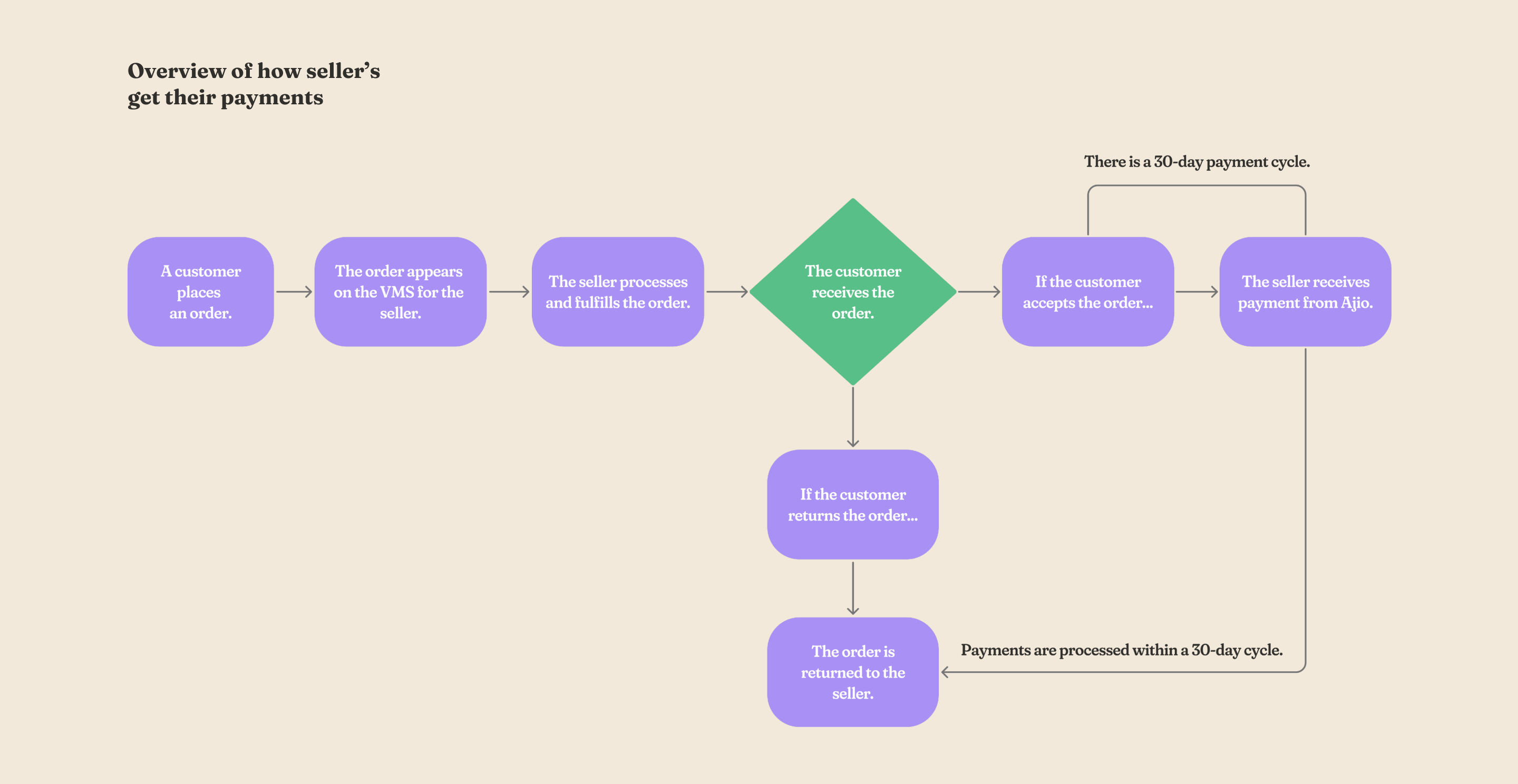
Steps to Reconciliation (Before)

Step 01
Data Collection
- Download FWD Report (Source - VMS Portal)
- Download RTV Report (Source - VMS Portal)
- Download Payments Report (Source - SRM Portal)
Step 02
Manual Data Preparation
- Concatenate/link FWD Invoice and SKU
- Map new column with RTV invoices & SKU
- Combine multiple payments reports from SRM
- Use third-party tools
Step 03
Excel analysis & Reconciliation
- Create a Pivot table to summarize data
- Analyze Payment status

Step 04
Payment outcome understanding
- Payment cleared
- Due later/ outstanding
- Deductions ( lump- sum)
- Payments for returns
- Expected

Step 05
Verification & Support
Map data in seller internal system
Raise request / call the support team
Research Strategy
To grasp seller reconciliation challenges, we created a structured research approach that combines user insights, business constraints, and competitive benchmarking.
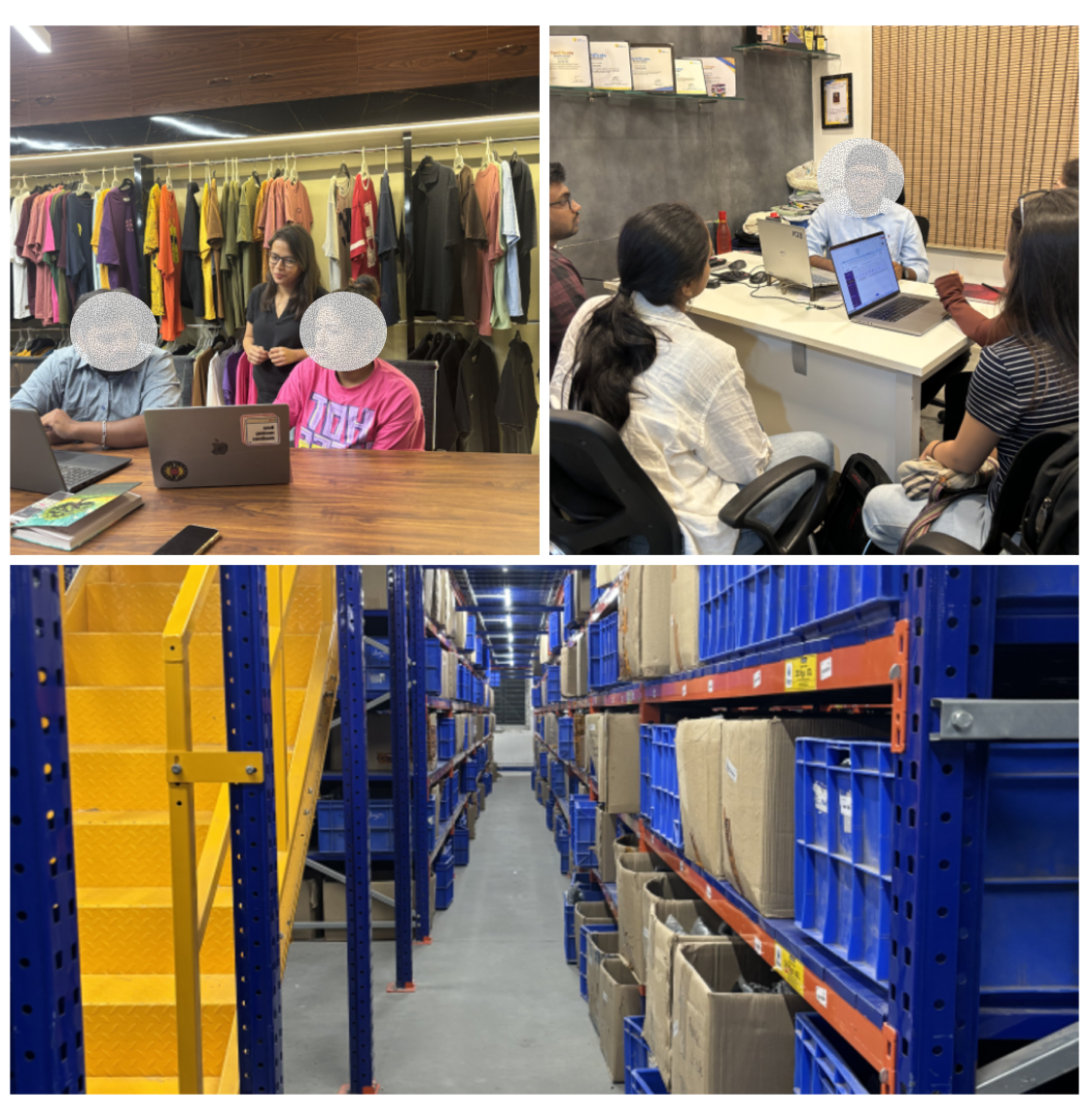
Competitive Bench-marking
We analyzed reconciliation and payments workflows across Flipkart, Amazon, Meesho, and Myntra to identify industry standards, gaps, and opportunity areas.
Moderated Seller Interviews
With reasearch team we conducted in-depth interviews with 10+ active sellers, including follow-up sessions to validate patterns and probe reconciliation workflows in real scenarios.
Cross-Functional Stakeholder Collaboration
Worked closely with finance and accounting teams to understand system limitations, reporting logic, deduction structures, and operational constraints.
Wireframes as Research Prototypes
Used early wireframes as discussion artifacts to uncover mental models, validate assumptions, and surface usability friction before finalizing solutions.
Context Setting
Sellers walked through their current reconciliation process and pain points.
Task-Based Exploration
Participants demonstrated how they track payments, identify deductions, and verify order-level details.
Validation & Deep Dive
Explored specific breakdowns, reporting structures, and trust-related concerns.
Synthesis & Pattern Mapping
Mapped recurring themes across sellers to define structural UX gaps.
Research insights
Before diving into research and designing, we carefully understood the current process of reconciliation
n = 12 sellers · single choice per question
75%
Use 3+ sources to
reconcile one transaction
(9 out of 12 sellers)
67%
Report low trust in payout accuracy
(8 out of 12 sellers)
92%
Export data to reconcile outside the platform
(11 out of 12 sellers)
01
How do you typically reconcile a payment with its order?
Problem:
There is no single place to view a complete transaction — sellers must manually piece together data from multiple disconnected reports.
Cross-reference 3+ reports
75%
(9)
Use 2 reports
17%
(2)
Platform is sufficient
8%
(1)
So we designed
A unified reconciliation workflow — all payment sources consolidated into a single view, eliminating the need to switch between reports.
02
What is your primary anchor when tracing a payment discrepancy?
Problem:
Payouts arrive as unexplained lump sums — sellers cannot verify what was deducted or why, eroding trust
Invoice no/clearing doc
75%
(9)
Payout date
17%
(2)
Product SKU
8%
(1)
So we designed
An order-first information hierarchy — Order ID is the top-level entry point across the entire interface,
mirroring how sellers naturally navigate.
03
When reviewing payments, what do you look at first?
Problem:
The platform presents raw transaction data with no summary layer — sellers must scroll through detailed records to get a basic overview.
Overall payout summary/overview
86%
(9)
Individual order detail
6%
(1)
Fee breakdown first
8%
(1)
So we designed
Progressive disclosure — a summary layer sellers can scan at a glance, with the ability to drill into
transaction-level detail on demand.
04
How confident are you that deductions from your payout are correctly explained?
Problem:
Sellers have no way to verify whether deductions from their payout are accurate or justified — the platform provides no itemised breakdown of fees, taxes, or adjustments.
Not confident at all
42%
(9)
Somewhat confident
33%
(2)
Fully confident
25%
(1)
So we designed
Transparent breakdowns — every payout shows itemised fees, taxes, and adjustments so sellers can verify each deduction without guessing.
05
How often do you export payment data to reconcile outside the platform?
Problem:
No single export covers the full picture — sellers download multiple files and stitch them together manually in spreadsheets.
Every payout cycle
70%
(7)
Occasionally
24%
(2)
Never
6%
(1)
So we designed
A consolidated downloadable statement — one export covering orders, fees, and payouts, ready for offline reconciliation without stitching files together.
Solution
A unified reconciliation ecosystem that brings fragmented payment data into a transparent, self-serve experience with clearer traceability and payout visibility.
Solution
01
Unified Reconciliation with Clear Payment State Separation
Consolidated fragmented payment data into a single reconciliation view while clearly separating Settled and Outstanding Payments, giving sellers immediate visibility into received versus pending funds without switching between reports or manually stitching data together.
Before
- No single source of truth
- Mixed view of payments with no clear distinction between settled and pending amounts
Now
- One consolidated system
- Clearly separated views for settled and outstanding payments
Solution
02
Invoice & Clearing Document–First Reconciliation Flow
Re-structured the reconciliation experience around Invoice and Clearing Document IDs as the primary anchors, aligning the interface with real payment processing workflows while improving traceability and simplifying reconciliation.
Users have the ability to thoroughly investigate cleared payments by accessing detailed information about settled payments. They can drill down into specific transactions by utilizing the clearing document number as their reference point.
Users can investigate outstanding payments by reviewing outstanding details and drilling down into specific transactions using the invoice number as the anchor.
Before
- Not structured around invoice or clearing documents, forcing sellers to manually piece together payment records and making reconciliation difficult to follow.
Now
- Invoice and Clearing Documents act as the primary reconciliation anchors, creating a more traceable and workflow-aligned payment experience.
Solution
03
Itemised Breakdown of Returns, Charges & Adjustments
Replaced opaque lump-sum deductions with detailed, drill-down breakdowns that clearly surface returns, charges, and adjustments, helping sellers understand exactly how deductions are calculated.
Before
- Deductions appeared as lump-sum amounts with little visibility into individual charges, returns, or payment adjustments.
Now
- Detailed, itemised deduction breakdowns provide clear visibility into every return, charge, and adjustment contributing to the final amount.
Solution
04
Overview - Drill down (Progressive Disclosure)
Introduced a layered information model—starting with a high-level financial snapshot and enabling deeper exploration only when needed.
Before
- Flat data with no clear navigation between summary and details
Now
- Seamless flow from overview to clearing docs to line-item details
Solution
05
Export-Ready Reconciliation
Designed exportable, structured data aligned with sellers’ offline workflows—making reconciliation faster and reducing dependency on manual tracking.
Before
- Sellers manually stitched and tracked payment data outside the platform
Now
- Structured ledger exports supporting faster offline reconciliation
Design Impact
Reconciliation redesign:
from fragmented to self-serve
This solution shifts reconciliation from a manual, multi-report process to a transparent self-serve system — giving sellers clarity, control, and confidence in their payouts.
From Complexity to Clarity
Before — old experience
3+ separate reports
Fragmented, siloed data across multiple files
Manual Excel reconciliation
Error-prone, time-consuming, no single source of truth
Lump-sum deductions
No line-item breakdown; sellers can't verify charges
Support dependency
Sellers rely on ops team to answer basic payout queries
After — new experience
1 unified view
All payout data consolidated in a single dashboard
Built-in reconciliation
Automated matching, instantly accurate and auditable
Transparent breakdown
Every deduction itemised; sellers can trace each line
Self-serve clarity
Sellers resolve queries independently, no ops needed
Impact metrics
Testing approach
Moderated task-based usability sessions
Conducted task-based usability testing with real sellers
Sample size: n = 12 sellers across segments
Each participant completed tasks independently without guidance
Behavioural insights used to estimate downstream impact
Result: 11 / 12 sellers completed all tasks independently
Key tasks tested
Three core seller payout scenarios
1
Identify settled vs outstanding payments in the payout dashboard
2
Trace a specific payment via invoice number or clearing document
3
Understand and verify individual deductions with line-item breakdown
All other impact metrics (↓ Support, ↑ Trust, ↑ NPS) are estimated based on behavioural improvements observed during testing — not directly measured.
80%
Usability success
11 of 12 sellers completed all tasks independently
Measured
↓ Support
Dependency reduced
Clear self-serve flows reduce ops team load
Estimated
↑ Trust
Seller confidence
Transparent breakdowns improve payout
confidence
Estimated
↑ NPS
Projected uplift
Improved clarity and usability enhance
satisfaction
Projected